

Why I'm Not a Grifter
Incentives, Principles, and Playing the Long Game

In 2023, a superPAC running influence operations for Robert F. Kennedy Jr.’s presidential campaign approached social audio creators with an offer: $500 per episode to promote RFK on the mic. The money came with one condition—keep quiet about where it came from. I was among those approached. I declined.
I’m telling you this not to congratulate myself. I’m telling you because it’s the cleanest possible illustration of what I want to talk about: a moment where the grift was legible, the money was real, and I said no anyway. Not because I’m a saint. Because I’m not an idiot.
Grifting, as I’ll explain below, is irrational and runs against basic moral principles. If it were merely the latter, you might call me a boring rule follower. But since it is both, we must contend with what the decision to grift really costs.
What is Grifting?
Let me define my terms before someone else does it for me.
A grift is the act of deceiving or manipulating people—through charm, selective framing, or outright fabrication—for personal gain. It’s intentional. It’s repeated. And crucially, it’s not a mistake but a deliberate act. Mistakes are for amateurs. Mistakes happen once or twice. A grift is a business model.
All public intellectual work involves performance to some degree. Every writer curates, shapes, selects. The question isn’t whether you’re putting on a show—it’s whether the show is rigged. The grifter isn’t a performer who happens to be wrong sometimes. The grifter is a performer whose relationship to truth is purely instrumental: say something true when it pays, play it fast and loose or utter something straight up false when that pays better.
A Continuum of Performers
There’s a spectrum here. On one end, the prudent performer—someone who has a genuine point of view, plays to their strengths, and builds an audience around who they actually are. On the other end, someone like Tucker Carlson, who once had at least the ghost of an editorial conscience, has become a readymade content-delivery vehicle for whoever’s paying him (monetarily or with tribalistic approval). Multiple former colleagues and peers across the political spectrum noted the change. He used to have guardrails. Then those guardrails came off, and what lay underneath was a loudmouth whose microphone serves as real estate for the highest bidder.
What’s worth noting is that grifters rarely operate alone. The grift almost always involves latching onto an existing tribe—an identity, an ecosystem, a political team—and using that infrastructure as both audience and cover. Tucker has his. Hasan Piker has his. The Lincoln Project has its donor class and its Blue MAGA readership. The tribe provides the recurring revenue and the insulation from scrutiny, because the audience is too invested in the product being real to examine it closely.
Which is why some of the most sophisticated grifters are the ones who claim to have no tribe. The self-styled centrist, the “I’m just asking questions” independent, the above-the-fray truth-teller who performs balance while reliably serving one constituency’s emotional needs. These people are often worse than the open partisans, because the performance of neutrality is itself another grift. They’ve just built a bespoke tribe out of people who tell themselves that they don’t have a tribe. The tell is the same as always: follow the incentives, watch who never gets hurt, notice whose ox is never gored. Those who can’t be criticized are often pulling strings.
What I’ve Declined, Again & Again
Here’s what I notice about my own situation, and I want to be specific because vagueness is where dishonesty hides. I write primarily on Substack. My most successful pieces—the ones that drove the most subscribers, the most shares, the most paid conversions—have been my most pointed critiques of the left. I know this. I can see the numbers. And I know what that means: there is a lane available to me. Show up every week with a variation on The Left Went Too Far. Build a reliable, monetizable audience of people who want to hear that. Keep chasing the same highs. Optimize the machine.
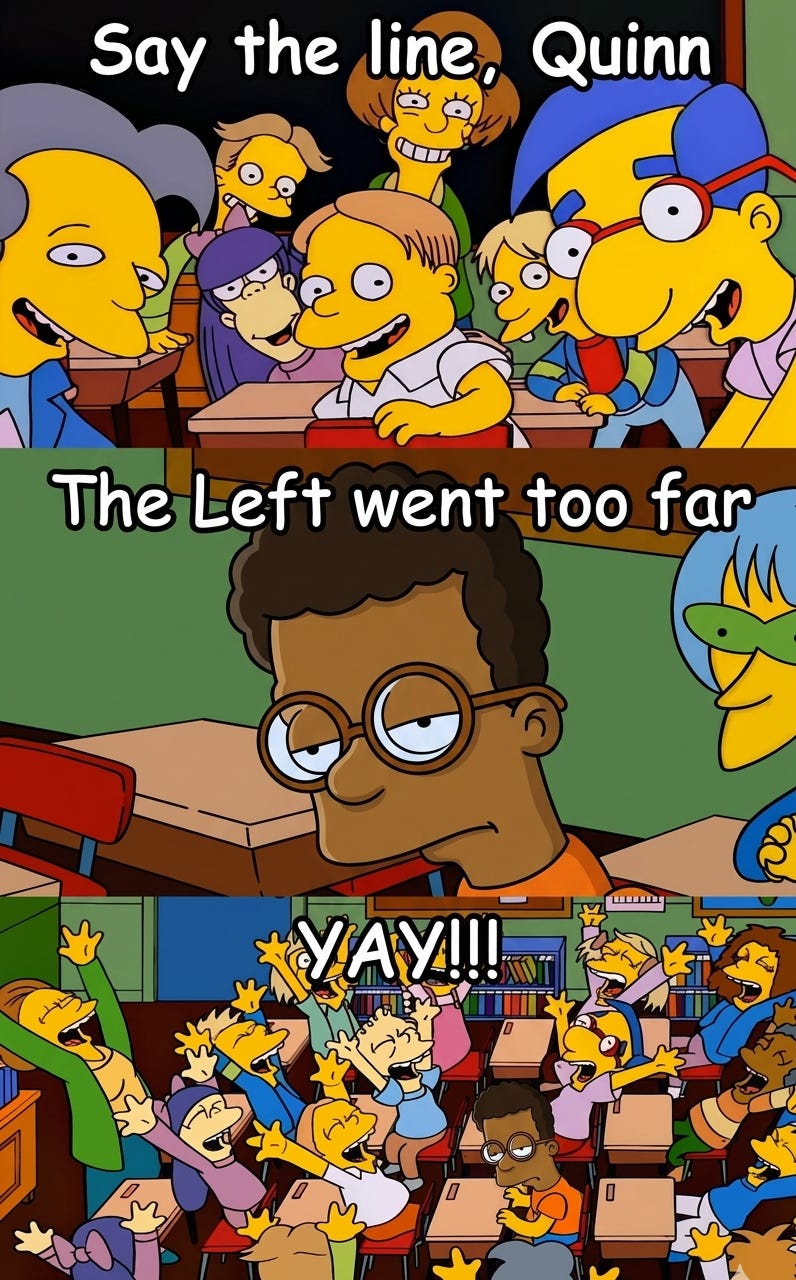
I refuse to do it. And I want to be honest about what that refusal costs me. If the engagement patterns hold, I could probably be clearing north of $500 a month—reliably, predictably, at a time when I need the money—if I committed to that angle. Maybe closer to $1,000 if I pushed it hard and picked up a regular writing gig to go with it. That’s real money. Life-changing money, at my level. Especially writing around a service job and building something from scratch without institutional backing.
But here’s the thing about that lane: it requires me to become someone I’d find embarrassing. A bad impression of writers I don’t particularly respect, cranked out on schedule for an audience that doesn’t actually want my thinking. Instead, it’d be like digital minstrelsy. My face on a polemic that’s predetermined and preconditioned.
I refuse not just out of principle, but because I’ve earned enough trust from some readers to know that they’d follow me there. I have a responsibility. I have a platform. I have a choice. In some ways, that makes it worse, not better.
Grifting is Irrational
Now let me make the case that isn’t about pride or moral realism. Let me make the rational argument. It’s far too under-discussed in these instances. Grifting is the quintessential short-term play. It’s failing the marshmallow test every day, forever, and at scale. And eventually, the marshmallows run out.
The first way they run out is structural. The grift depends on burning a resource it cannot replenish: audience trust. In the creator economy specifically, trust is the product. Substack’s entire pitch to writers is that you own the audience relationship directly—just you and the people who pay to read you. That’s an extraordinary asset, and it’s almost perfectly designed to be destroyed by grifting. Every misleading piece, every audience-pandering slop post, every position held for clicks rather than conviction quietly debits the account. The grifter is spending down the only capital that matters in the belief that the balance will never hit zero.
The second way is cognitive. Research on the psychology of deception consistently finds that lying requires significantly more mental load than telling the truth—more working memory, more executive control, more active suppression of what you actually know. That cost is manageable for a single lie (even if that’s still beyond the pale). It becomes ruinous at scale. The grifter isn’t telling one lie; they’re maintaining an entire alternative reality. Some try to keep them internally consistent across hundreds of pieces of content. Others just assume onlookers won’t notice or care.
Either way, the system becomes increasingly fragile and increasingly expensive to run. The scaffolding gets more elaborate. The contradictions accumulate. The grifter ends up spending enormous energy not on producing good work but on managing the structural debt of prior bad work. Especially if competing inducements lead to conflicting grifts. Which is almost inevitable with epistemic mercenary work.
The third way is what happens when the freeride ends. When an ecosystem has enough honest actors to keep audiences from total cynicism, that’s one thing. But since that trust is a finite resource, the bill coming due gets ugly fast. We’ve seen this movie with legacy media. The institutional press didn’t lose the public’s confidence in a single scandal—it lost it through accumulated small betrayals, through audiences slowly noticing the product was shaped by forces other than truth-seeking. Indie media is running the same experiment on a faster timeline. The grifters who crowded in over the last decade are already producing the backlash that will eventually clean house. When that happens, the people with actual track records will be positioned to absorb the audience that’s finally sick of being played.
This isn’t idealism. It’s the difference between a gambler who doubles down on every bet and one who diversifies. The long-term thinker wins by default because they’re not dependent on the audience of marks. On everyone else playing straight and floating their epistemic debt. Creators I respect, ones I try to emulate, they’re building something that survives contact with reality. That survives crashes and media bank runs. I think one is coming for indie media, and I plan to be well-positioned for it.
Freedom to Say “No”
There’s a version of the objection I want to address: The argument being that my service job backstop, my lack of dependents, my current position outside the system—these make it easier to be principled, and I should be careful about how much credit I take for it. This is partially true, I don’t dispute it. Yes, it’s easier to say “no” to $500 an episode when your rent doesn’t depend on it. And being outside institutional structures means I’m not navigating the go-along-to-get-along pressures that push otherwise decent people toward epistemic cowardice inside those structures.
But by that logic, only the destitute can be credited with integrity, because there’s always some hypothetical worse circumstance, some rock bottom, that the non-grifters never reach. The place where they might have broken. Yet the fact remains I’ve always been broke, and I’ve increasingly had the option to burn the marshmallows or to save towards them. I think my choice matters; the counterfactual matters too.
And for what it’s worth: being outside the system also removes the institutional antibodies. Nobody’s watching my back. When a superPAC comes with a bag of money and a wink, there’s no editor, no HR department, no mentor to consult. I said “no” without help. Others said “yes.” We see how that worked out for each side.
Rizz-light; Morally-loaded
There’s one underappreciated diagnostic: Grifters are smooth. Even the combative ones—the ones who make their name going after people—are performing a very specific kind of aggression. It’s calibrated. Righteous. Always framed as reluctant truth-telling, as the common-sense position that only a fool or a villain could oppose. The grifter’s attacks are designed to feel good to the audience receiving them, which means they’re ultimately in service of the audience’s comfort, not the truth. The target is always someone the base already dislikes. The political risk is functionally zero.
I don’t do that. I’m disagreeable in ways that don’t serve any obvious constituency, including my own. I’ve annoyed the left, the center, and the right in the same news cycle. I’ve pushed back on readers who were praising me for the wrong reasons. I’ve declined some overtures when I thought values weren’t aligned. I’ve told current and former friends when I thought they were fucking up. None of that is charming. Some of it has cost me. But the grifter’s version of conflict is always a performance of conflict—it flatters the audience while appearing to challenge them. Real disagreement feels different. We can tell, even when we don’t like it.
My philosophical ground does real work here, and I’m not going to dress it up as something more modest. I believe there are objective facts about what’s right and wrong, both morally and epistemically. Facts that don’t bend to convenience. I believe the obligation to engage in good faith with your audience is one of them. I can’t pick and choose when my principles apply without the principles ceasing to be principles—they’d just be preferences to invoke. Cheap, flimsy things, unfit to purpose.
Conclusion
The grift is bad strategy and it’s wrong. Both are true. The second doesn’t go away just because the first is also sufficient.
I’m aware that writing an essay called “Why I’m Not a Grifter” is a bit on nose. But this isn’t about a clever rhetorical move or CYA. It’s just what I needed to say in this moment. After I criticized the left. After I defended art from the culture war industrial complex. After I declined both sides of the reactionary and atavistic content machine.
Not only because I’ve never been paid by shadowy forces. But because I cracked one thousand subscribers whilst pissing off a large chunk of the internet along the way. I did it my way, cuz I felt like saying what was on my mind. No more, no less.
If there’s a consistent agenda running through all my pieces, it’s telling the truth and damning the consequences. The work is the argument. I can’t make you believe that, because, as I’ve said before, persuasion is predetermined. I can only speak my piece.
And if you’ve been reading long enough, you already know that’s what I’m here for.
Brilliant stuff. The line about the marshmallow test made me laugh out loud. Makes me think of all the players out there who are blatantly squandering their audience’s trusts.